
Wang Haichuan's Quarantine Diaries - A Set of Acrylic Paintings on Tibetan Paper

“…time wasn’t passing…it was turning in a circle…”
--Gabriel Garcia Marquez, Hundred Years of Solitude.
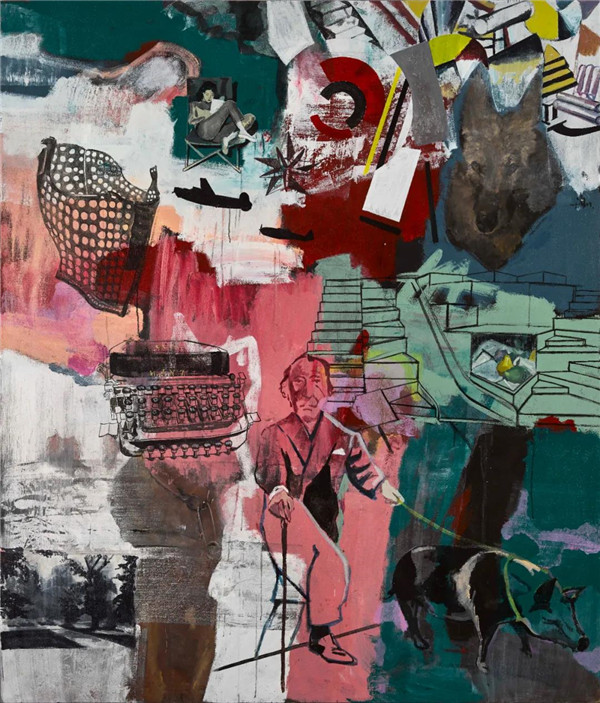
Wang Hichuan, Art Writing
Acrylic on canvas
180x170, 2020
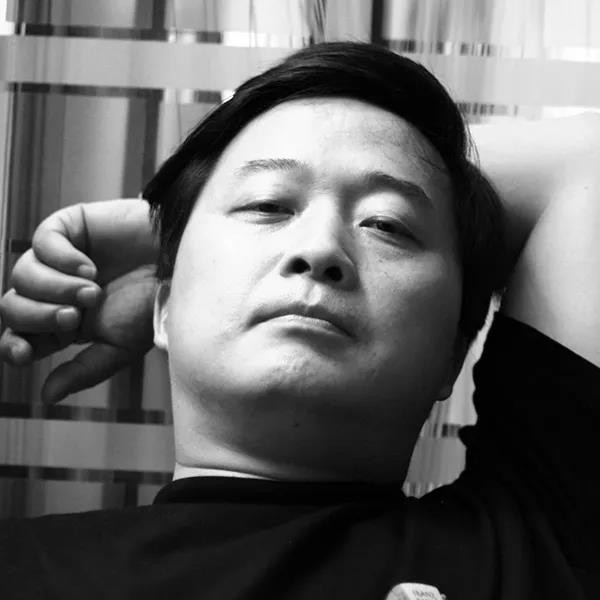
Wang Haichuan
Wang Haichuan was born in 1968 in Jilin Province, China, and currently lives and works between Beijing and Chongqing.
Wang Haichuan was another artist in this current group exhibition who immediately reflected on the new bewildering normal of 2020 in his artworks. The beginning of the quarantine meant the beginning of his diaries on Tibetan paper, with each artwork titled accordingly with the day of its creation.
In 1997 he graduated from the Sichuan Fine Arts Institute, with a major in visual arts. He used to work in the field of architecture and landscape for many years and is widely recognized as a visual artist. Wang Haichuan’s works destroy the superficial characters of private lives and harmonious society. He attempts to demolish the trace of reality and replace it with relics of time. His works were featured in solo, as well as group exhibitions and art fairs within China and abroad.
Wang Haichuan's quarantine diaries is a set of acrylic paintings on Tibetan paper. The basis of this paper is a root of a local poisonous plant, which is known to be insect-proof and long-lasting - this led to it being used to write religious scripts or contracts. His works and the use of this material display communication with his spiritual self, as well as landscapes, architecture, patterns or human figures. Wang painted quickly as if he were capturing a dream on this spiritual paper, which is often difficult or even sometimes impossible to grasp.
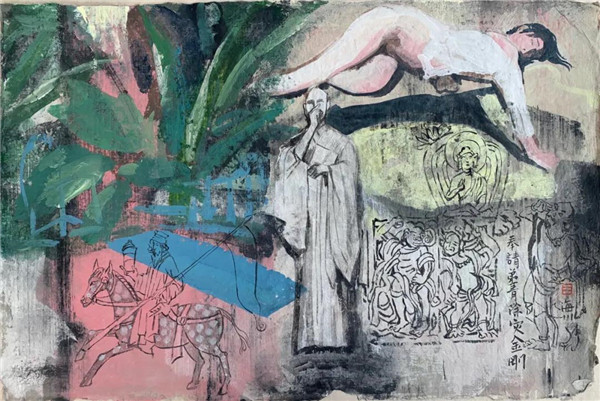
Wang Hichuan Feb.14
Acrylic on Tibetan paper
25.5x37.5cm, 2020
Characteristic of his work is a combination of eclectic imagery, floral decorative patterns, fragments of architecture, stretches of layered paint, and above all an obvious enjoyment of storytelling. His work created on February 3rd “Feb.3” tells of the news reports circulating through Chinese media on that day. The news talked about the new coronavirus originated from bats in the South China seafood market. Another announcement, that seemed to present a bigger danger at that moment, delivered the news about the locust outbreak in Africa that threatened to reach China. It went on elaborating on how successful management of the locust outbreak in China in the past was stopped with the help of geese and ducks - locusts’ natural enemies. In the painting, an old lady is ready to load her giant goose on the truck. On the stem over the truck sits a considerably oversized locust nibbling on the grass, right next to him is a bat just as significant in size. Further on the right is a Buddhist deity hovering over the whole scene. And who knows it might have just the power to eradicate those threats and bring peace of mind to humanity...
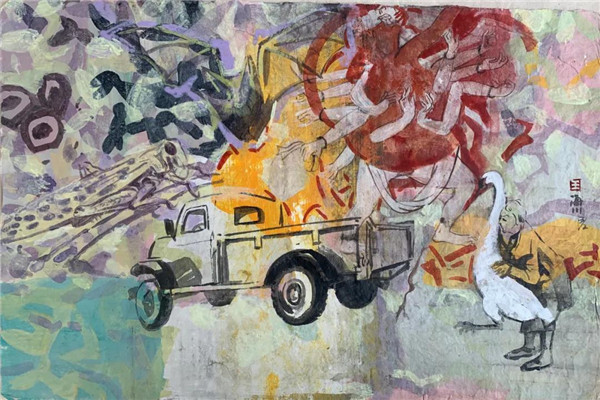
Wang Hichuan, Feb.3
Acrylic on Tibetan paper
25.5x37.5cm, 2020
Over the past several years, Wang Haichuan has made a number of drawings whose most distinct shared feature is the combination of various images constructed by a certain internal logic. Most of those images come from the Internet, a place infested with images and therefore the most convenient place for picking up images. Arguably, the mass production and transmission of images are reshaping our knowledge about the world and are swaying our judgments. Like ordering food from a menu, we have always made our judgments based on an image. Therefore, with Wang Haichuan, images are both his drawing objects and the components of his works, the reason of which is that there are a certain reason and context to whatever objects we choose.
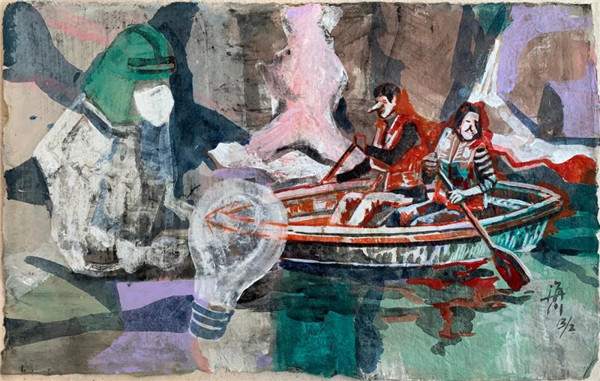
Wang Hichuan, Feb.13
Acrylic on Tibetan paper
25.5x37.5cm, 2020
For Wang Haichuan, the decision to pick particular ones out of a myriad of images is influenced by our outlooks, or more specifically, our political outlooks. It is this outlook that leads to the presence of many of the past or present political events or settings in his drawings. Through those drawings, or rather through the compilation of those images in his drawings, Wang Haichuan dug deep into the proper thinking or outlooks that contemporary generation ought to have towards the present society. In other words, what makes art modern lies in its capacity for prompting assessment and thinking on the living environment of mankind.
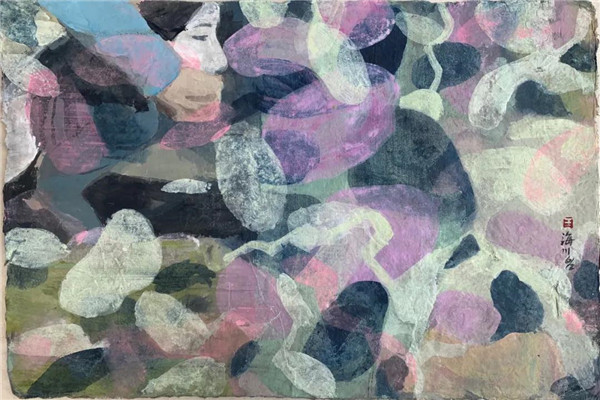
Wang Hichuan, Feb.6
Acrylic on Tibetan paper
25.5x37.5cm, 2020
With his adept mastery of drawing techniques and by taping into the structure of Japanese Ukiyoe, Chinese folk drawing and Persian miniature, Wang Haichuan was able to introduce to his Tibetan paper drawing a new style different from the common schematic style drawing, bringing rich fragmented stories to the audience.
“For me, images have their special significance in defining things. We are living in a time riddled with images and the images you chose will come to define your outlook on the world. Because of the sense of boredom that comes with schematization and the sense of “transparency” that the audience may feel, I try to steer clear of being rigid in my drawing. By combining various images, I was able to create many stories that cannot otherwise be told by words to communicate with the audience. In a sense, I have retained a touch of the reading characteristic of illustrated books, turning those drawings into my “modern Ukiyo-e” - Wang Haichuan
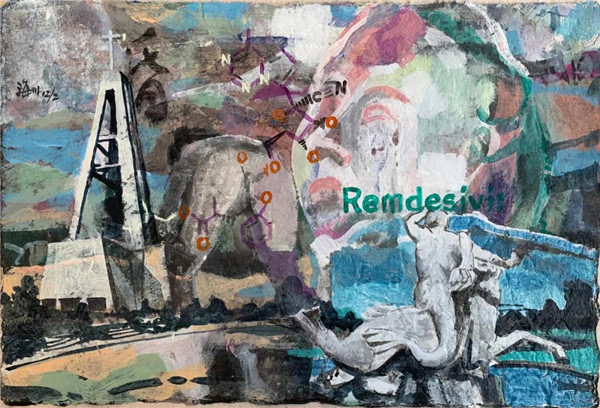
Wang Hichuan, Feb.12
Acrylic on Tibetan paper
25.5x37.5cm, 2020