
Interdisciplinary Artist Aziz Hazara Wins $100,000 Future Generation Art Prize

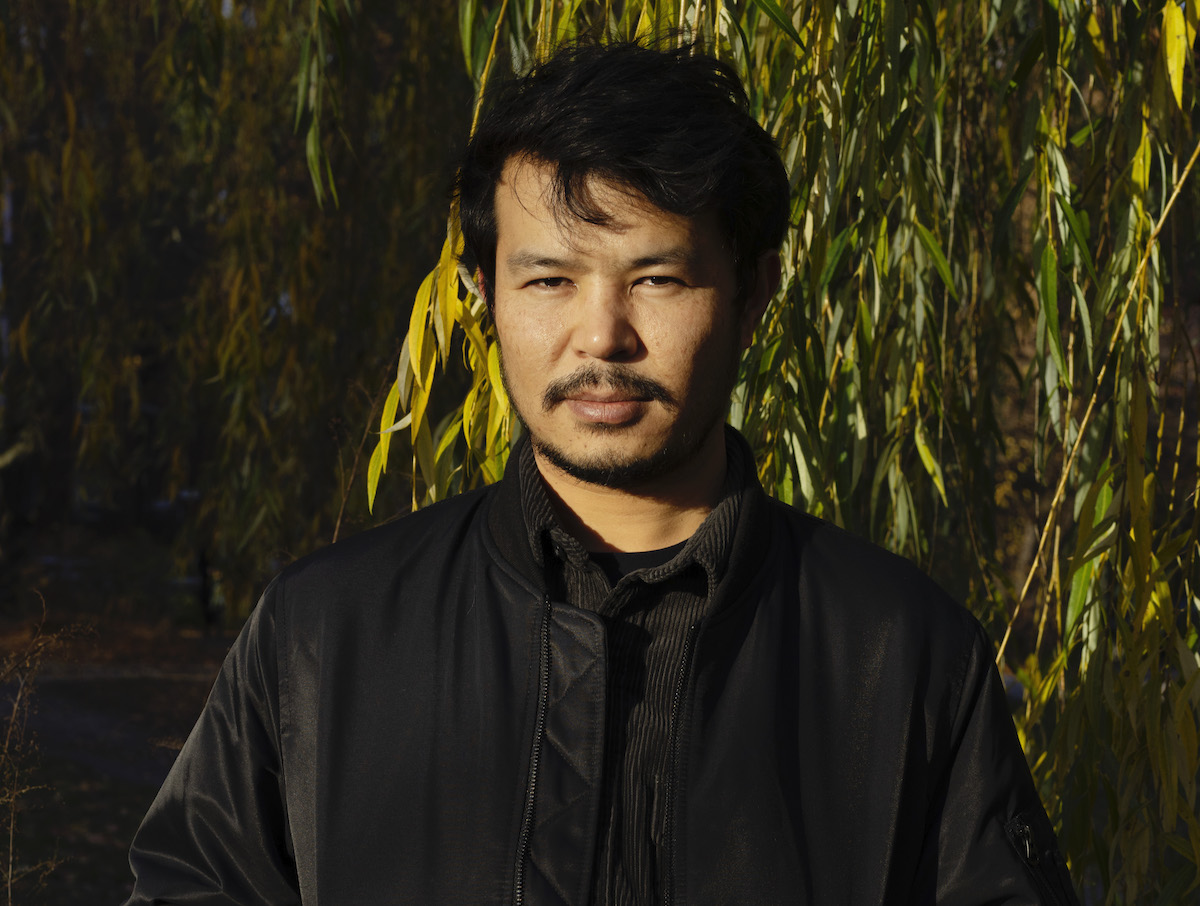
Aziz Hazara.
PHOTO MAKSIM BELOUSOV/COURTESY THE ARTIST AND PINCHUKARTCENTRE
Last December 8, renowned interdisciplinary artist Aziz Hazara took home the Future Generation Art Prize 2021, an award established by the Victor Pinchuk Foundation and given to artists under the age of 35. Besides the distinction, he was also given a total of $100,000 – $40,000 of which will be used to fund his practice.
An additional $20,000 was distributed among Special Prize winners Agata Ingarden from Poland, Mira Lee from South Korea, and Pedro Neves Marques from Portugal.
“Nobody can tell us better about this world than great, especially young, emerging artists,” said Victor Pinchuk, the founder of the PinchukArtCentre and the Future Generation Art Prize. “You are able to express the future of this world much better than politicians can. My belief is that contemporary art is one of the most revolutionary forces in the world. That is why I think your role is so important.”
He added, “You can influence and help us to change this world. We can survive only if we change this crazy world with its very dangerous and unpredictable future.”
Hazara was chosen by an international jury, which consisted of some of the art world’s most influential figures, including Lauren Cornell, the Director of the Graduate Program and Chief Curator at the Center for Curatorial Studies at Bard College; Elvira Dzangani Ose, the Director of the Museu d’Art Contemporani de Barcelona in Spain; and Eugene Tan, the Director of the National Gallery Singapore and the Singapore Art Museum.
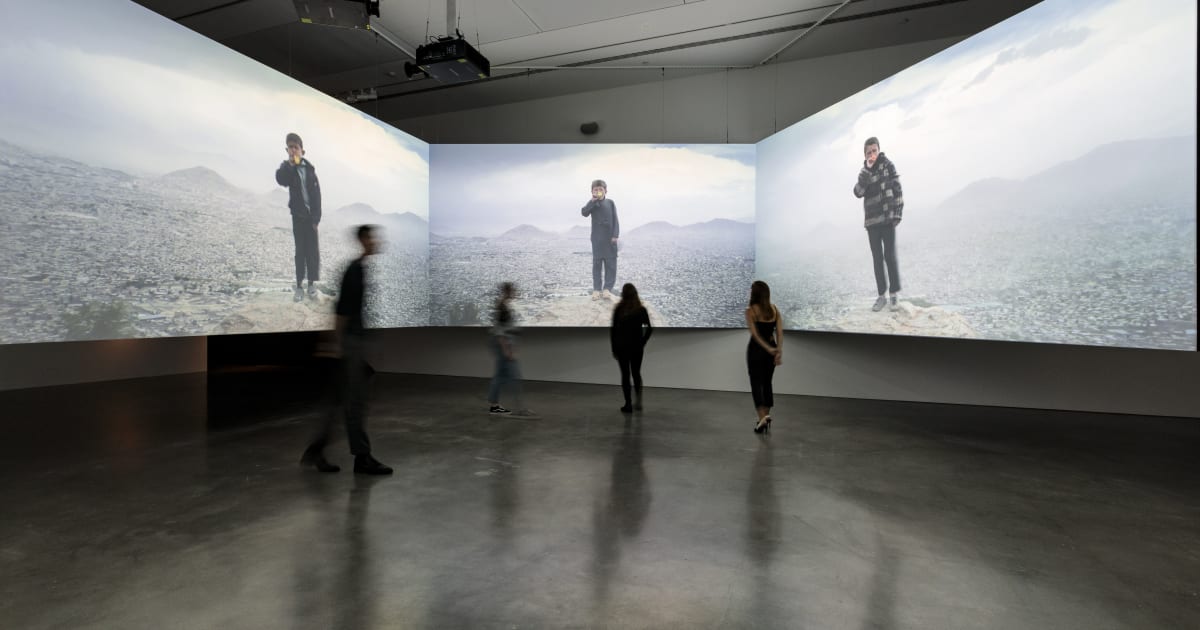
Bow Echo, 2019
Image via experimenter.in
Based in Kabul, Afghanistan and Ghent, Belgium, Hazara is known for working across photography, video, sound, language programming, and text to explore power relations, geopolitics, and the panopticon. His work “Bow Echo” (2019) is a multimedia installation spread out across five screens, showing a young Afghan boy climbing mountaintops and playing a plastic bugle. It was previously shown at the 2020 Sydney Biennale.
“The piece holds many paradoxes in a simple scene: the playfulness of childhood, the limitlessness of grief, the conquest of land and territory, and the precarity of the future,” said the international jury in a statement. “In a sense, the piece identifies not only a future-facing tendency in art but a concern for future generations that was shared by many artists in this year’s Future Generation Prize.”
The panel added, “Touching on cinema, performance, and sound, ‘Bow Echo’ offers a striking time-based monument to resilience and hope for a geography that has, for many generations, remained under the pressure of various forms of failed governance. At the same time, the piece shows how artists continue to imagine complex independent ways of existence even amidst conflicts that seem never-ending.”
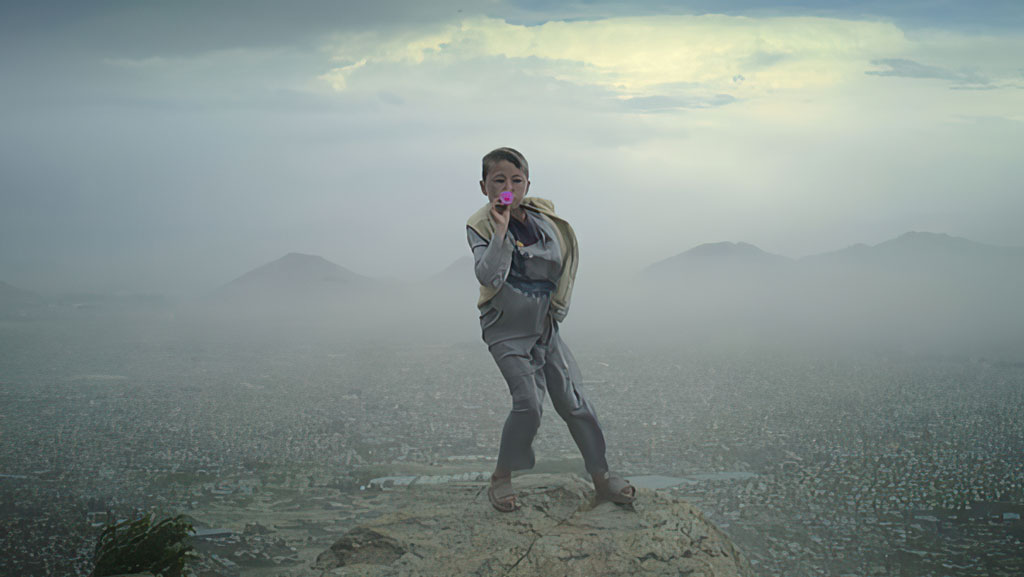
Aziz Hazara, Bow Echo (Video still), 2019, Duration: 4 min 6 , Five channel HD video, color, sound, Video produced by the Han Nefkens Foundation,
© Aziz Hazara, Courtesy the artist, Han Nefkens Foundation and Fundació Antoni Tàpies
Hazara has previously stated that “Bow Echo” is a response to the resistance of the local Afghan community – especially in Kabul, where he was born. While the city has been plagued by conflict since the U.S. military intervention began in 2001, its situation became even more precarious last August when the Taliban recaptured control. Given this, it isn’t unsurprising that the five-screen multimedia installation resonated with the international jury.
Established in 2009, the Future Generation Art Prize is organized by PinchukArtCentre, a private museum in Kiev, Ukraine. As one of the top awards in the art world, many regard it as predictive of emerging young talent on the verge of an incredible breakthrough.
Image via new.pinchukartcentre.org/en
“This idea of the Future Generation Art Prize came to me in 2008 in the middle of the global financial crisis,” said Victor Pinchuk in his speech at the awards ceremony. “Maybe for you – young artists – it would be useful to know and understand that crisis is a fantastic source of inspiration. Nobody can tell us better about this world than great, especially young, emerging artists. You are able to express the future of this world much better than politicians can.”
The Future Generation Art Prize has previously been won by the British artist Lynette Yiadom-Boakye (2012), Carlos Motta of Colombia and Nástio Mosquito of Angola (2014), and the Lithuanian visual artist Emilija Škarnulztė (2019). An exhibition of the short-listed artists for this year’s award will be on show at the PinchukArtCentre until February 27, 2022.
-End-