
Restored Vermeer Painting Revealed a Hidden Cupid

Johannes Vermeer

Born in October 1632, Johannes Vermeer is one of the most highly regarded Dutch Golden-Age artists of all time. His paintings have been a source of inspiration for centuries, known for their luminous quality and captivating depictions of mundane domestic scenes.
Only 34 of Vermeer’s paintings have survived to the present day, which is perhaps the reason why many are fascinated by them. Among the most well-known ones is his 1665 masterpiece “Girl with a Pearl Earring,” which continues to wow audiences, thanks to the ethereal appearance of its subject.
Girl Reading a Letter at an Open Window
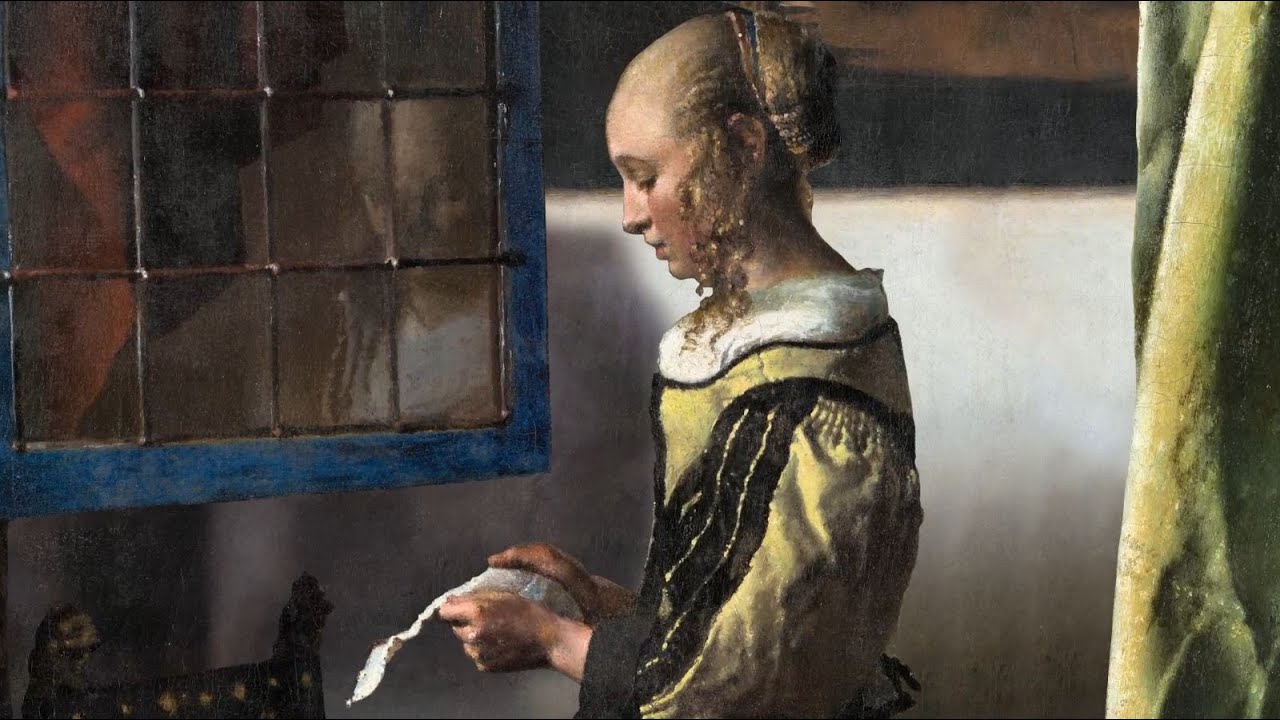
Just a few days ago, the art world was once again buzzing with Vermeer’s name, although this time, it was because of a stunning image of Cupid revealed in his “Girl Reading a Letter at an Open Window.” Housed at the Gemäldegalerie Alte Meister in Dresden, Germany, this painting was completed sometime between 1657 and 1659 and has been in the museum’s collection for more than two centuries.
The existence of a hidden Cupid in “Girl Reading a Letter at an Open Window” is far from a secret. It was discovered in 1979 when the painting was subjected to an x-ray and again in 2009 when it went through infrared reflectography.
Since then, many have assumed that Vermeer himself had painted over the image, perhaps in a bid to put the focus back on the central subject.
However, a major restoration project launched by the Staatliche Kunstsammlungen Dresden in 2017 revealed that this isn’t the case at all.
Image of Cupid
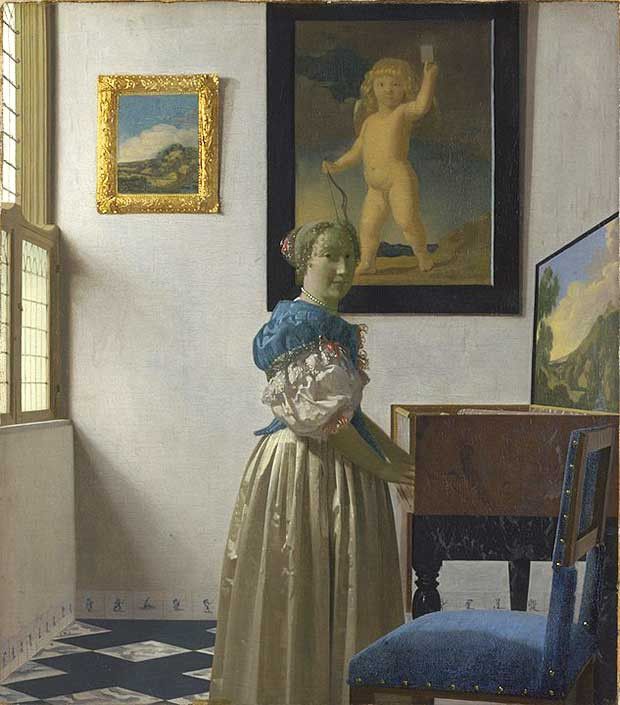
Johannes Vermeer, A Lady Standing at the Virginal, oil on canvas, c. 1670-1672, National Gallery, London © Wikimedia Commons
Rather, conservators discovered that the layer of paint covering up the image of Cupid was actually added long after Vermeer’s death in December 1675. Its “solubility properties” were found to be different from those used elsewhere in “Girl Reading a Letter at an Open Window,” but only after stripping away layers of 19th-century varnish was this contrast noticed.
To support their observations, the team working on the restoration project subjected the painting to tests in an archaeometry laboratory. The results showed that layers of binding agent and dirt lay between the image of Cupid and the paint used to cover it.
It led conservators to conclude that several decades would have passed before Cupid was painted over. Thus, the earlier theory of Vermeer himself covering it up as a means of self-editing was proven to be false.
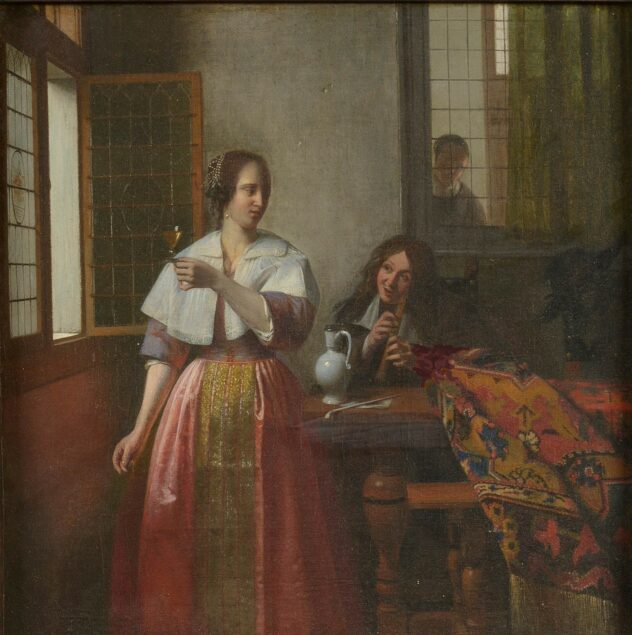
A young woman with wine glass, 17th century
Many in the art world are excited about this discovery, claiming that it gives audiences a new understanding of the painting. Some scholars have even put forward the idea that Vermeer intended to indicate the girl was reading a letter from a suitor or a sweetheart, since Cupid is traditionally associated with love and romance.
“With the recovery of Cupid in the background, the actual intention of the Delft painter can be recognized,” said Stephan Koja, the director of the Gemäldgalerie Alte Meister. “Beyond the ostensibly amorous context, it is about a fundamental statement about the nature of true love. Now, we understand it as a key image in his oeuvre.”
His sentiments are shared by Uta Neidhardt, the museum’s senior conservator. Not only has she referred to the discovery as the “most sensational experience of [her] career,” but she also said in an interview that “The elements of disguised and concealment play a less dominant role in this early work by Vermeer than the composition whose background was changed by another hand led us to believe.”
However, some aren’t happy about the restored Vermeer. For them, the figure of Cupid in the background takes away from the painting’s simplicity and introspective atmosphere.
Restored Vermeer
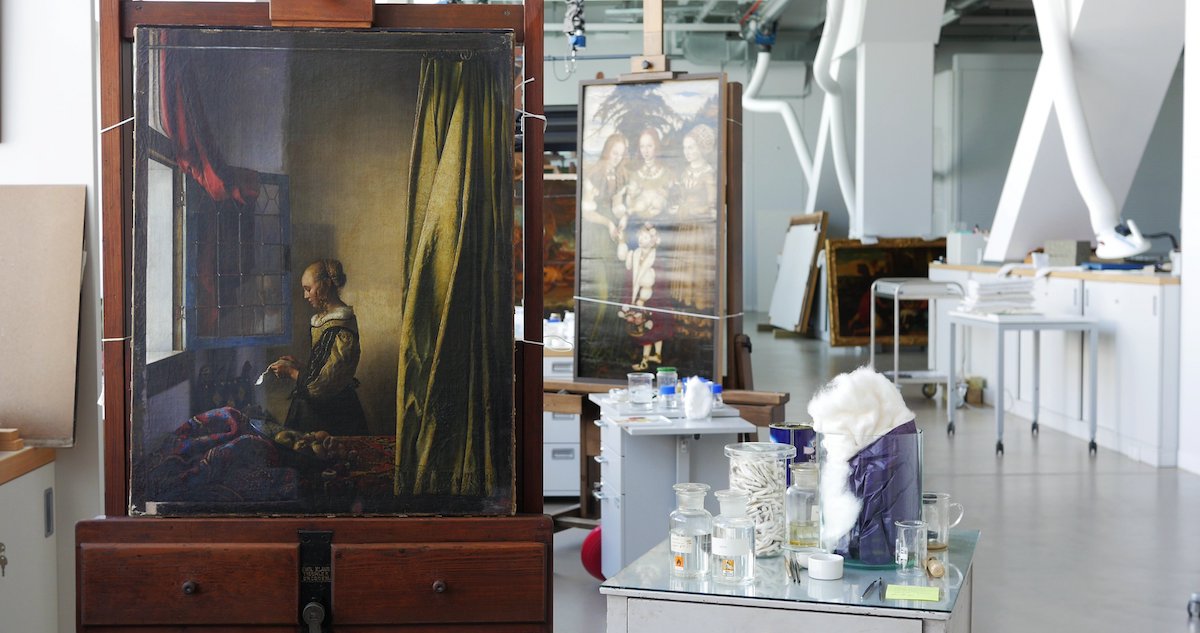
Regardless of what its detractors have said, the formerly hidden figure of Cupid will be restored to its full glory. As of right now, the image is only half-exposed, but the museum’s conservators, led by Christoph Schölzel, are working hard to scrape away the layers of varnish covering it.
The semi-restored “Girl Reading a Letter at an Open Window” will be the centerpiece of an exhibit at the Gemäldegalerie Alte Meister, to be curated from May 8 to June 16. Joining it are nine of Vermeer’s other famous paintings, including “Woman in Blue Reading a Letter” (1663-64), which will be displayed on loan from the Rijksmuseum in Amsterdam, the Netherlands.
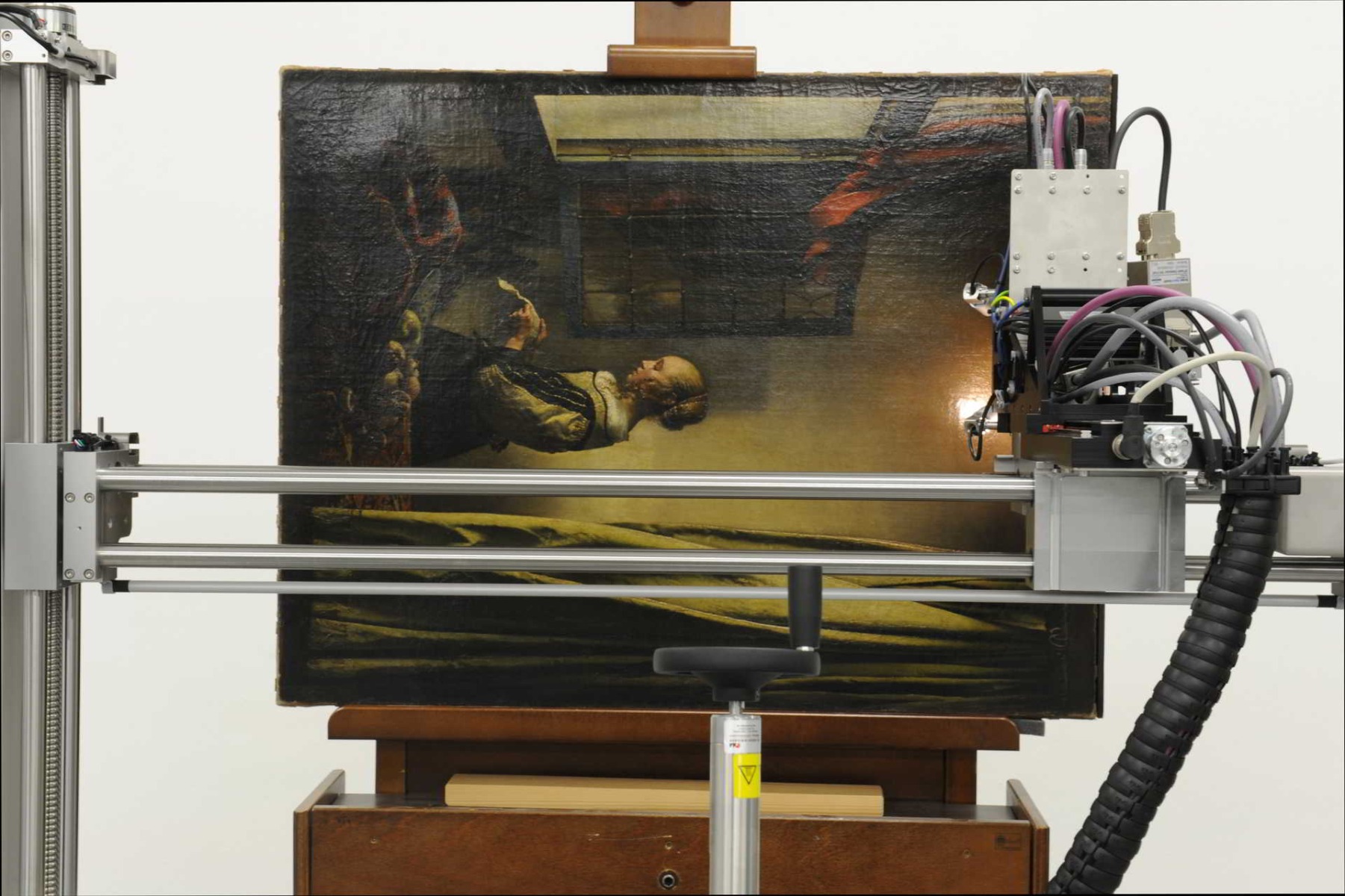
An x-ray fluorescence spectroscopy of the painting’s entire surface was carried out in 2017 (Photo: Maria Körber – © SKD)
Other paintings from Dutch artists will also be included, such as a few from Pieter de Hooch, Frans van Mieris, and Gerard Ter Borch.
Some classic paintings can be presented to modern audiences again through restoration technology, which is very shocking, it is a dialogue between classical and modern. We can also reproduce classic paintings through copying and imitation so that more people can take their own famous paintings home and decorate their dreams. If you want to learn more, feel free to get in touch SOA-Arts.